Category: Islamic reflections

  • Muslim, Single, Female – What is my purpose?

    Muslim, Single, Female – What is my purpose?

    Muslim, Single, Female | What’s my purpose?

    A couple of days ago, I came across a post on an all-women Facebook group where a young Muslimah asked about how to find your purpose in life. A sentence that stood out to me said: “Please do not tell your kids that marriage is their purpose. As an unmarried woman, I do not relate.”

    The dilemma faced by our smart sister is the same for many of us. The societal pressures of finding a spouse and having children in order to fulfil the narrative our families have painted for can become daunting. Can we be unmarried and still lead a fulfilling, purposeful life? Here’s my take on it.

    Marriage is a beautiful institution, yet it is only a part of life and not your whole life. We need to make our youth feel included, even if they haven’t gotten married yet. To associate the purpose of life with marriage naturally makes the young feel worthless. The idea is to not denounce marriage but to guide the youth on how to go about life when they haven’t yet received the rizq of marriage. Yes, make du’aa, take measures to get married, have tawakkul in Allah, learn about what marriage is, and inshallah, Allah will grant you the best. Until then, do your best to be among the best slaves of Allah, utilizing the capabilities and resources that Allah has bestowed upon you now. There’s a huge list of things that we can do to fulfil our purpose in this Dunya. Before diving into “how,” let’s first see “what” the purpose is.

    Allah subhanahu wa ta’ala mentions in the Qur’an:

     “I have not created the jinn and humans except for my worship.”

    (Surah Az-Zaariaat, 51: 56)

    Does that worship entail only prayers, fasting, hajj, etc.? No doubt, all these acts are noble and fard acts of worship with immense virtues, yet worship in Islam is a comprehensive and wholesome concept. In the words of our teacher and well-known da’ee of our times, Dr. Bilal Philips, worship in Islam is a broad concept – every act is a potential act of worship provided we do it with sincerity to Allah, and follow the Sunnah; even the act of going to the toilet and relieving ourselves can earn us rewards if we follow the Sunnah of reciting the du’aa of entering the toilet, stepping the left foot in the toilet first, stepping out with right foot first and saying the du’aa of coming out. SubhanAllah,this concept can be extended to all realms of life. Therefore, if someone becomes a doctor or psychologist or any medical-related position, intending to gain Allah’s pleasure through treating the ill people, it is an act of ibadah. If a person becomes an engineer, or a teacher, or starts a business with the intention of providing Muslims with relevant facilities in an Islamic way, then these too become acts of worship.

    Thus, married or not, we can utilize our potential to be among the best slaves of Allah by making the best of our abilities and time, inshallah. If you are good at writing, you can write to educate people about Islam and other subjects. If you can cook or bake you can start a small business out of it and provide people with halal foods, and spend from that income on charity. If you like to paint or draw or are interested in arts and crafts, you can make cards for different occasions, or gift Quranic/Hadithic du’ass or azkaar writing and designing them beautifully. If you have the knowledge, you can surely share it with others. Last, but not least, the best resource you have is yourself and your time – you can spend it listening to a grieved soul or an elderly or lonely person and listen to the burden on their chest. Doing all of these, for the sake of Allah, will earn you tremendous rewards. In sha Allah.

    One thing we can all do, no matter what our age or occupation or location is – seek knowledge. The most virtuous of all areas of knowledge is that of deen that one can never claim to have acquired fully. In addition to that, participating in programs related to self-grooming and self-awareness is also an immensely valuable investment we can make in ourselves.

    Youth is a prime time when we can learn more about ourselves, our strengths and weaknesses, and our triggers and motivators, and hence operate from a position of awareness. The process of learning about oneself is extremely helpful in marriage as well – only when we fully know ourselves are we able to determine what type of a person is compatible with us. 

    Thus, married or not, we can do a lot. Yes, as spouses and parents, we can make a big impact on our family and society, but that doesn’t mean we can’t if we aren’t one of these two. So, yes, spouse and kids are not end in and of themselves rather means to an end; and we keep getting different means at various stages of our lives, Alhamdulillah. The rizq of marriage and kids will arrive when Allah allows them to. The thing is to not attach our hearts to temporary means, but to the ridaa (pleasure) of Allah since the purpose of our “entire” life is to worship HIM – and there are limitless incentives for that. We only need to focus on the present and value it and make the best of it, In sha Allah. 

    Make every day count, look for opportunities every day, do every act with taqwa seeking the rewards from Him alone. In this way, we will be fulfilling our purpose every single day, inshaallah.

    May Allah make us among the best of the people who benefit others the most and make each moment of our lives a moment of ibadah and of closeness to Him, Ameen.

    Written by Afeerah J. Khan

  • Hijama – A forgotten sunnah!

    Hijama – A forgotten sunnah!

    Hijama – A Forgotten Sunnah!

    “Indeed in cupping there is a cure.” – (Sahih Muslim, Hadith : 5706)

    Cupping, an age old healing and remedial procedure practiced worldwide for centuries.

    From the Ancient Egyptians in the 1550BC, to the Chinese and Europeans who practice this form of healing till date.

    It is a process in which a vacuum is created within a cup and the cup is thereby placed on the body of the patient. The vacuum then creates a pressure from within and sucks the muscles inwards and draws blood to the cupped area, this is otherwise known as ‘Dry Cupping.’

    However, another form of cupping that is widely recommended as the Sunnah, is called Wet Cupping or Hijama – where the cup is removed and small, shallow incisions are made in the same area before the cup is placed back. Pulling out the toxic blood, acids and excess fluids from the body.

    Hijama – literally means to ‘return to normal state’ of internal well-being by removing toxicity and stagnant blood from the body. Several hadiths and narrations prove the authenticity of the holistic nature of this medical technique and the benefits it boasts.

    The Prophet Muhammad (SAWS) said: “The best thing with which you can treat sicknesses is cupping.”

    The best treatment is cupping, it removes blood, lightens the back and sharpens the eye sight. (Al Hakim 4/212, Al Tirmidhi, Hadith: 3053)

    Hijama is renowned as a cure for the mind, body and soul. It can have the following effects on the body:

    • Improves circulatory and immune system,
    • detoxification
    • treats illnesses and relaxes patients,
    • relieves pain,
    • aids in fertility,
    • Treats Neurological, cardio vascular and muscular issues,
    • Alleviates depression and anxiety,
    • and removes black magic.

    Ibn al Qayyum (May Allah have mercy on him) mentions that the Messenger was cupped on his head when he was afflicted with magic and that it is one of the best of cures for this, if performed correctly.”

    The Islamic calendar predominantly depends on the lunar cycle, and studies have discovered that the lunar cycle has a massive influence on the physiological and behavioral patterns of humans and animals. As an Islamic form of therapy, Hijama is performed under strict Islamic guidance and in accordance to the religious rules.

    • The three sunnah days when Hijama is recommended to be performed are on the 17th, 19th and the 21st of every Islamic month.
    • Patient and practioner should perform ablution and the procedure should take place with the Qur’an recitation.
    • The sunnah points of Hijama are on the upper back. Helps cleanse and unblock major arteries and veins, as it aims to target the heart, lungs, brain and spine.

    Unfortunately, this blessed practice is a fast disappearing sunnah, and it is upon us as Muslims to revive it once again and create an awareness of the multitude of benefits it possesses that are almost immediately effective and can be vouched for by the patients. Hijama should be the form of medical aid people should start considering resorting to more often than not.

    Written by Safra Nawasdeen

  • Do Not Fall into the Trap of Believing in Prophecies!

    Do Not Fall into the Trap of Believing in Prophecies!

    Do not fall into the trap of believing in Prophecies!

    Spirituality is a huge part of us Muslims. The happiness we feel from reading the Quran is one example of when we experience it. Likewise, we feel tranquillity and higher concentration while praying in a congregation in the Masjid. In addition, many women feel pride when they wear their scarf in an especially modest way during Ramadan. All of these are all otherworldly feelings that are too good to describe. However, where is the limit to which we can attribute our happiness and success to our own perfection or Allah (swt)’s satisfaction?

    It is one thing to believe in the Unseen (which we cannot see, including the jinn, angels, and future). It is another thing to believe that we understand it beyond what is taught to us. A few examples of ‘prophecies’ that are invalid because they are based on incorrect beliefs includes: crystal globes, horoscopes, astrology including star signs (not to be confused with astronomy, which is a proven science), using ancient religions as a guide, or even modern religions other than Islam.

    A few interpretations of dreams are based on pagan beliefs, and decisions made from them set the interpreter to failure. In fact, if one looks at the way people feared the end of the world in the year 2012 much of the theories were rooted in the ancient Mayan civilisation that ended years ago. The Mayan religion did not hold the belief of the world ending at this date, yet this did not stop conspiracists from making claims of their own. The golden rule that Muslims must abide by is that if Allah (swt) did not say that an event will happen, nor is there a logical reason for us to decide that it will occur, then it is not befitting to make claims on such.

    It is suitable that false prophesying is a sin due to its misleading nature. Even the Prophet (peace and blessings of Allah be upon him) said: “Whoever goes to a fortune-teller and asks him about something, his prayer will not be accepted for forty nights.” Narrated by Muslim (2230). This is despite if what the soothsayer is saying becomes true or if they are using ‘Islamic’ evidence as reference. The signs of the day of judgement are clear, and anything that extrapolates from this is involving oneself in haram.

    Written by Nour Jamal

  • Two Types of Busy

    Two Types of Busy

    Working hard is a significant part of being Muslim. Laziness is not a likeable trait. We must always strive our hardest to achieve our goals, and not expect anyone else to do our work for us. Hard work is something that only two types of people can do. These two types of people have different intentions, which are, for the sake of Allah (swt), and for the sake of themselves.

    Those that work for the sake of Allah (swt) have a high value because of the amount of humility they hold in their hearts. It is patience that keeps them pleased and content. Patience is a rare gift that not many people can say they have.

    Among the things that the Prophet (pbuh) said on patience was this:

    “Whoever refrains from asking others, then Allah will make him content. Whoever would be independent, then Allah will make him independent. Whoever would be patient, then Allah will make him patient. There is no gift that is better and more comprehensive than patience.”

    (Sahih al-Bukhari 6470, Sahih Muslim 1053)

    Here independence is seen to be linked with patience. Both independence and patience are the result of perseverance and putting in effort. These qualities cannot be achieved by being lazy. There is another intention that could make a person a hard worker which is self-interest, or wordly interest. This type of purpose is shallow when compared to enduring hardships for the sake of Allah (swt). May Allah (swt) accept our prayers when read the Quranic verse:

    “Verily, my Salat (prayer), my sacrifice, my living, and my dying are for Allah, the Lord of the ‘Alamin” Quran 6:162

    Written by Nour Jamal

  • Facing the Double Standards of Free Expression and No Judgement

    Facing the Double Standards of Free Expression and No Judgement

    Freedom of Expression vs No Judgement

    These recent days have been mentally disturbing for me, thanks to social media – a selectively open space to throw out anything you want. Why do I say selectively open? Well, my entire frustration is about this very notion.

    Referring back to the title, in our world today, these two concepts are held as default moral values. Let everyone express whatever they want. Let’s not judge anyone for anything. Let’s make this world a peaceful place embracing diversity. Innocent ideas, right? Then why am I frustrated with them? Sigh, because of their excessively selective nature!

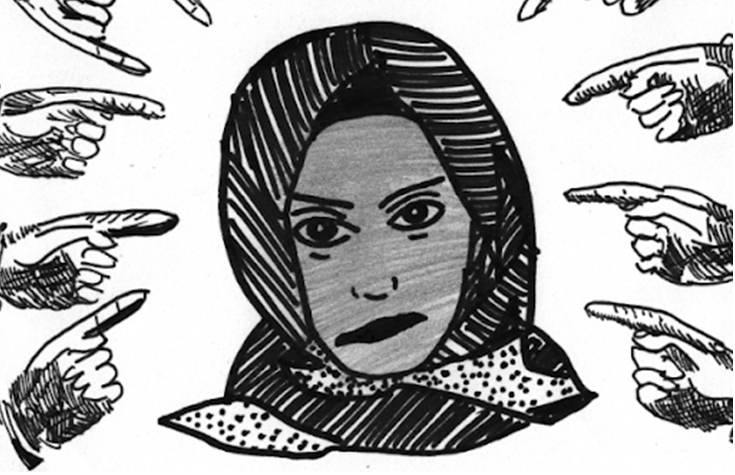
    You see, when a Muslim woman who covers herself, observes hijab and niqab, she is hurled at with a dozen labels such as: oppressed, stupid, unintelligent, out of style, backward, a slave to husband/father, letterbox, witch, extreme, meek, weak and the list goes on. They chant these inconsiderate, harsh labeling as freedom of expression.

    However, when a woman is wearing tight or revealing clothing such as a bikini etc. and someone dares to express their dissent even indirectly, the same flag bearers of freedom of expression let loose their rage and a series of name-calling of another sort starts. They now throw far away from their freedom of expression flag and hold high the no-Judgement flag, vehemently opposing and trying to prove that this person is shameless and shouldn’t ever talk about how a woman dresses. To express it more clearly: no one should say anything or even think anything when a woman wears nearly no dress, but make it their obligation to herald their vulgar talk when seeing a burqa-clad woman. What

    DISCREPANCY!

    No, I am not trying to advocate deciding heaven or hell for people based on their dress or shaming them brutally. What I want to say is that the people who hold the value of freedom high must do so for everyone around them, not for a selected few.

    The picture is so clear today if we open our eyes and minds: the ideas and morals presented by the West today are nothing but a nose of wax. They turn things to serve their motives whenever needed, and in whatever way they please.

    Let’s take another example, they say that whatever happens in someone’s bedroom must not be a concern for anyone but the related two – be it illicit sex, homosexuality, etc. They completely accept and think of it as an achievement when a man/woman has multiple “partners” without marriage and chant this as “cool” stuff. These same people raise fingers and mock polygyny. If they are such accepting and embracing people, why do they have a problem with whatever goes on in a Muslim’s life. They seem so possessive of their bedroom life, then why mock a Muslim’s personal life.

    They celebrate women who dress up for a random man on the street but insult a Muslim woman for covering up. If a half-nude woman is free to express herself, then by your logic, a completely covered woman should not be harmed too. Why do they have a problem with a Muslim man not shaking hands with a non-mahram but find it completely okay when a man flirts with women. Each person has their own way of life. Why mock one and venerate the other?

    These are just a few examples of the self-centered values promoted by the West, and the world of social media keeps popping up newer examples that affect a Muslim’s mental and psychological well-being.

    • Their call for “free” acceptance is “bound” by their own likes and dislikes.
    • Their call for “freedom” of expression demands an absolute “slavery” to their own thinking.
    • Their apparent loving arms are actually clutches of hatred.

    What can one do if not feel frustrated by this attitude? Yes, this life is a test, and the higher the faith, the bigger the test. We just have to have tawakkul in Allah and must keep following our religion no matter what they say.

    What I would like to suggest to my Muslim sisters and brothers is to never compromise on their practice of deen or feel ashamed of it. Just keep obeying Allah and advising one another to truth and patience in an appropriate way. We aren’t here for people in the first place, we are here to worship Allah alone sincerely. So let’s just keep going, in sha Allah.

    یُرِیۡدُوۡنَ اَنۡ یُّطۡفِئُوۡا نُوۡرَ اللّٰہِ بِاَفۡوَاہِہِمۡ وَ یَاۡبَی اللّٰہُ اِلَّاۤ اَنۡ یُّتِمَّ نُوۡرَہٗ وَ لَوۡ کَرِہَ الۡکٰفِرُوۡنَ ﴿۳۲﴾

    They want to extinguish the light of Allah with their mouths, but Allah refuses except to perfect His light, although the disbelievers dislike it.”

    Surat No 9 : سورة التوبة, Verse 32

    [Translation by Sahih International]

    Written by Afeerah J. Khan

class="adsbygoogle" style="display:block" data-ad-client="ca-pub-1112325522634372" data-ad-slot="8128808900" data-ad-format="auto" data-full-width-responsive="true"